Small Playroom Ideas: Make Room for Play Without Losing Your Living Room
For a lot of families, the "playroom" is the living room. Or one corner of the dining room. Or the floor between two beds in a shared bedroom.
That's completely normal. And you can make it work without a dedicated room, a big budget, or a Pinterest-perfect shelf.
A good play space isn't about more toys. It's about fewer, better ones, set up so your child can actually use them (and so cleanup doesn't land entirely on you).
Before you buy anything, ask three questions
- Can my child use this in more than one way?
- Can it fold, store or move easily?
- Will it still be useful a year from now?
If the answer is yes to most of these, it earns its place.
Tired-parent shortcut: leave some floor empty. Children don't need every inch filled. Open space gives them room to move, build and settle into play.
Quick picks: what's your biggest problem?
- Your toddler climbs everything → a foldable climbing triangle
- You want a slide, not a permanent one → a folding wooden slide
- Toys end up all over the floor → open shelving
- You need a table, a step stool and a chalkboard → a 4-in-1 toddler tower
- Books are everywhere → a child-height bookshelf
-
Pretend play wants a lot of space → a doorway play store or a 3-in-1 play station
If your child climbs every piece of furniture
The sofa, the coffee table, the dining chairs. If your toddler is a climber, you're not dealing with bad behavior. You're dealing with a child whose body is telling them to move, test their balance and try something harder.
You probably can't stop the climbing. You can give it a safer place to happen.
A foldable climbing triangle gives them a proper structure to climb on, and it folds away when you need the room.
Our picks: Hazel Pikler Triangle, Ladder and Rocker Set · Foldable Climbing Triangle with 2 Ramps
Good to know: set it up on a clear, flat floor with a soft mat underneath, stay nearby, and follow the age and weight guidance for your piece.
Want a slide that doesn't take over the room?
Kids climb up and slide down again and again, and every round is real physical practice. The tricky part is finding one that doesn't become a permanent fixture before dinner or when guests arrive.
A folding wooden slide gives them the fun and folds away when playtime is over.
Our pick: Holland Wooden Folding Slide
Love the idea of a ball pit, but not the footprint?
Ball pits have a reputation for swallowing a room. Compact versions are far more apartment-friendly, and they offer climbing, crawling, tossing and sorting all in one spot.
Our pick: Compact Ball Pit
Tired-parent shortcut: bring it out for a few weeks, then put it away. It tends to feel brand new when it comes back.
Good to know: supervise play, and wipe down the balls from time to time.
Sometimes the best upgrade isn't a new toy
It's how you display the ones you have.
A toy box means digging, dumping and a floor full of everything. Open shelving lets your child see what's available, choose what they want and put things back in a spot that's clearly theirs. Many families find playtime goes more smoothly this way, and cleanup gets easier because every item has a visible home.
Shop: Open shelving
One piece of furniture, four jobs
In a small home, furniture that changes through the day is worth a lot.
A foldable learning tower that works as a step stool, a table, a chair and a chalkboard replaces several bulky pieces. Your toddler can help mix pancake batter in the morning, draw at the chalkboard after lunch, and have snack at the table in the afternoon, all at the same spot.
Our pick: 4-in-1 Foldable Toddler Tower
Good to know: use it with an adult close by, especially in the kitchen, and follow the manufacturer's age and weight guidance.
A reading corner that doesn't add clutter
Books deserve a spot as inviting as the toys. A child-height shelf lets small readers browse and pick for themselves. Facing the covers outward makes books far more tempting than a row of spines.
Even a tiny reading corner (a shelf, a cushion, a good lamp) can become the coziest spot in the house.
Our picks: Summer Tree Bookshelf · Bookshelf with Hidden Storage
Big imagination, small footprint
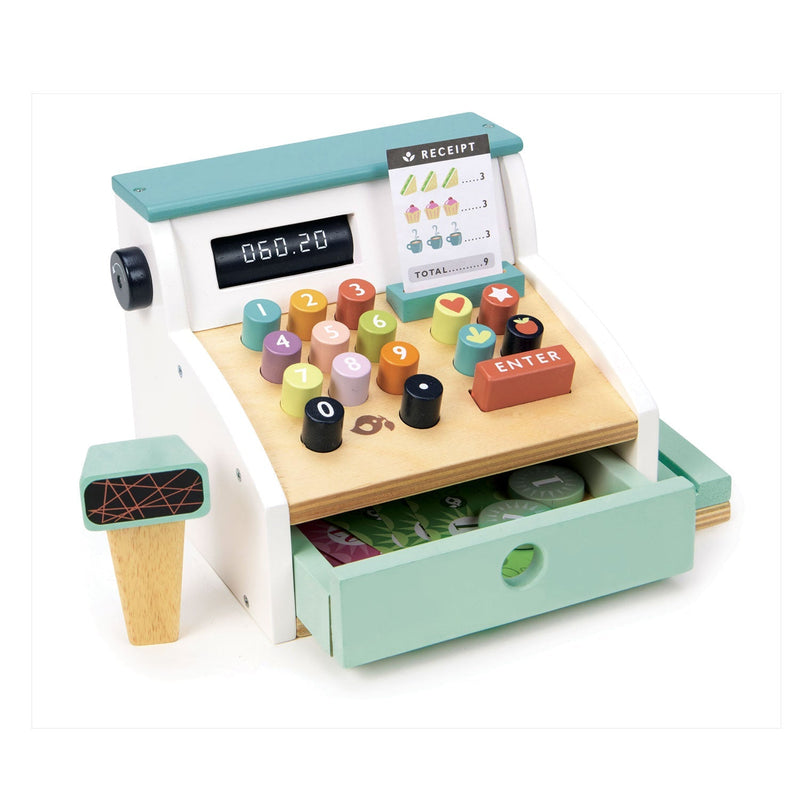
Pretend play doesn't need a giant kitchen or an oversized market stand.
A doorway play store or puppet theatre turns an ordinary doorway into a grocery store, café, bakery or stage. When playtime is over, it comes down and the floor is yours again. It works well in apartments, shared bedrooms and rooms that do double duty.
Our picks: Hanging Doorway Play Store · Doorway Theatre
Good to know: check that it fits your doorway and is mounted securely.
One play station, endless stories
The hardest part of a small home is choosing toys that don't outgrow their purpose in a few months. That's why we like multi-purpose pieces.
Instead of giving up floor space to a kitchen, a market stand and a workbench, one wooden station can be all three. One day your child is making breakfast. Next week they're running a shop. A few weeks later it's a workshop.
Our pick: 3-in-1 Play Kitchen, Store and Workshop
Tired-parent shortcut: don't put out every accessory at once. Rotate the play food, tools and market items every few weeks and the same station feels like a new game.
Toys that grow with your child
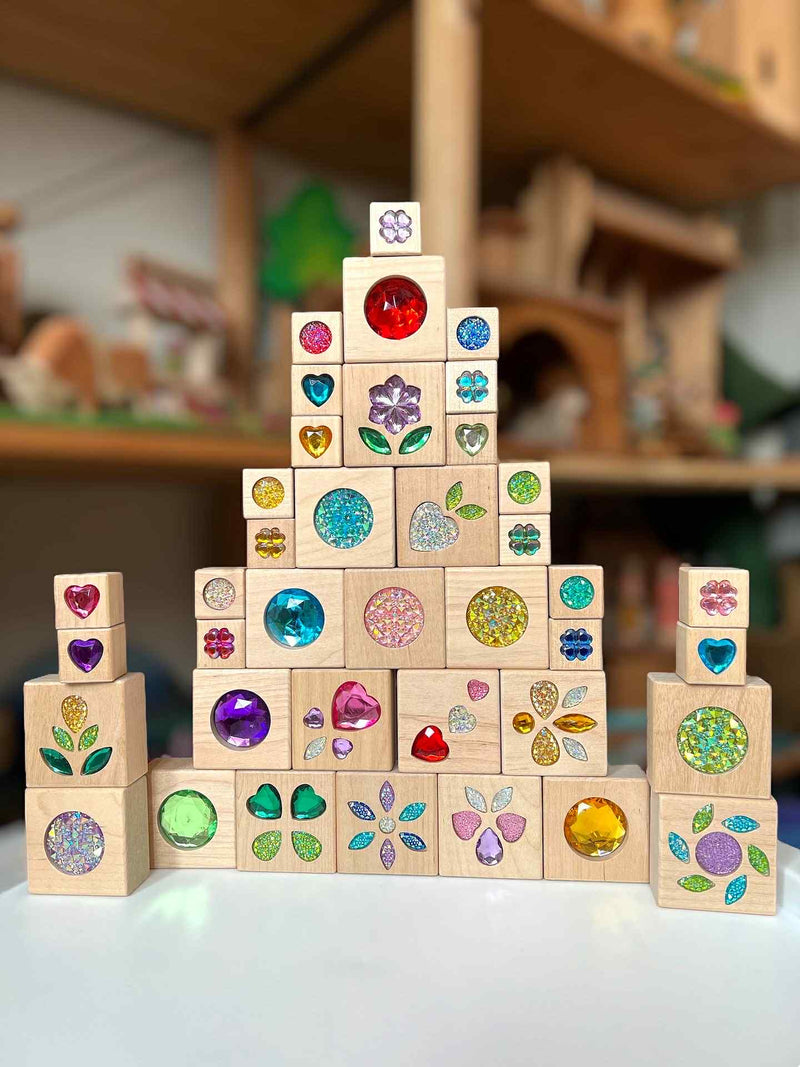
The best toys don't tell a child exactly how to play. Wooden blocks are a castle one day and a racetrack the next. Rainbow stackers become tunnels, bridges or pretend birthday cakes. Play silks turn into capes, picnic blankets, rivers and doll blankets.
When a toy can become almost anything, children come back to it. Open-ended toys also take up very little room.
Where to start
Pick one item that solves your biggest daily headache, and start there. Over time you'll build a play space that works for your child, your home and your sanity.
Nurture how they play.